Duncan Grant, Film of Abstract Kinetic Collage Painting with Sound, 1974. This is a digital film version of a scroll painting Grant composed in 1941. The music of Bach was meant to accompany it.
This just in! Plans are now being made for the 35th Annual International Conference on Virginia Woolf: Virginia Woolf and Sound.
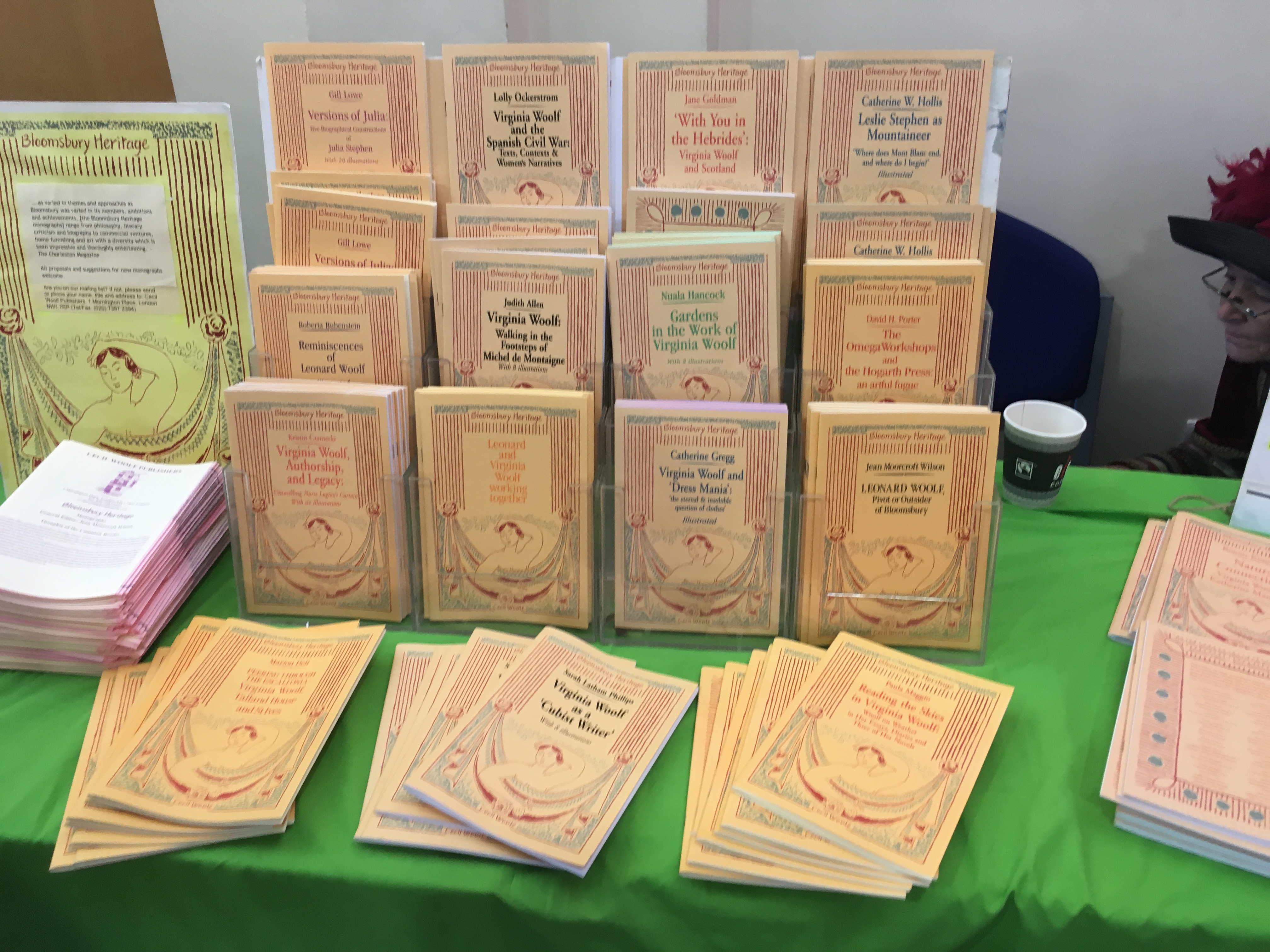
Some of the monographs in the Bloomsbury Heritage Series from Cecil Woolf Publishers. The monograph by Catherine Hollis, “Leslie Stephen as Mountaineer: Where does Mont Blanc end, and where do I begin?”, was published in 2010.
Editor’s Note: As of Feb. 19, the deadline for the call for papers has been extended to March 31.
The call for papers has gone out for the first-ever conference on Virginia Woolf’s father, Leslie Stephen, which will be held at Université Sorbonne Nouvelle in Paris on Oct. 24-25, 2024. The conference title is “Leslie Stephen: Thinking With and Against His Time International Conference.”
Abstracts of about 300 words, for 25-minute papers in English, together with a short (100-word) author biography, should be sent to the organizers by Jan. 31, 2024, at: leslie.stephen.conference@gmail.com.
A selection of peer-reviewed articles based on papers given at the conference will be collected for publication. In case of difficulties tracing Stephen’s works, please contact the organizers, who will be happy to share links and resources.
Organizers are Claire Davison (Université Sorbonne Nouvelle, Paris); Isabelle Gadoin (Université Sorbonne Nouvelle, Paris); and Marie Laniel (Université de Picardie, Amiens).
More details
PRISMES – EA 4398
Langues, Textes, Arts et Cultures du Monde Anglophone
CORPUS – UR-UPJV 4295
Conflits, Représentations et Dialogues dans l’Univers Anglo-Saxon
SEW – Société d’Études Woolfiennes
Confirmed keynote speakers
Dr. Jane Potter (Oxford Brookes University)
Dr. Trudi Tate (Clare Hall, University of Cambridge)
Call for papers
Early advocate of evolutionism, one of the first openly declared agnostics, editor of the Cornhill Magazine, pioneering mountaineer, moral philosopher, founder and general editor of the DNB: there are so many more facets to Leslie Stephen (1832-1904) than those recorded by his daughter Virginia Woolf, who memorably paid tribute to his “strong,” “healthy out of door, moor striding mind”. By unfolding all the contradictions and paradoxes of the character, this first international conference on Leslie Stephen means to reclaim the full complexity of his thought and legacy.
Thinking with and against his time, Stephen held a key position at the heart of the Victorian literary sceneand was an impressively prolific writer, profoundly engaged with the religious, philosophical and social debates of his age. A highly respected journalist and critic, he edited the Cornhill Magazine from 1871 to 1882, publishing works by George Meredith, Thomas Hardy, John Addington Symonds, Henry James and R.L. Stevenson, and was the author of hundreds of essays, published over the course of forty years in periodicals, such as the Fortnightly Review, Fraser’s Magazine, Macmillan’s Magazine, Mind, the National Review, the Nineteenth Century, the Saturday Review or the Pall Mall Gazette, a vast oeuvre now finally accessible thanks to online databases.
His devotion to knowledge and integrity were such that he preferred to break with the academic world of Cambridge rather than compromise with the Church. Heir to the Clapham Sect, Stephen engaged with the theological debates of his time to the point of gradually and publicly embracing agnosticism, a form of radicalism that coexisted from then on with forms of traditionalism.
His own prolific output bears witness to his encyclopaedic mind and his boundless curiosity for all the key issues of the day, however polemical: the anti-slavery movement, agnosticism, educational and social reform… Both a man of his time and a pioneer, Stephen explored new epistemological modes in keeping with the expanding frontiers of his age, while remaining profoundly anchored in some of the values and hierarchies of the day.
The Dictionary of National Biography (DNB), his life’s work, and one of his most ambitious projects, is the finest example of his desire to define new modes of classification and new forms of expression for the expanding knowledge of his time. Breaking with the established narratives of the past, he devised a new approach to writing the biography of the nation, doing away with the grandiose tradition of commemoration. In its place, he developed a more archaeological approach, delving into the past and collating the life stories of all those who helped shape the evolution of the country.
The same pioneering spirit stoked his passion for the Alps and mountaineering, in which he proved as much a trailblazer as he did in intellectual life. It is this conquering spirit that his close friend Thomas Hardy immortalized in his poem “The Schreckhorn, With Thoughts of Leslie Stephen” (1897), which extolled his will to “venture life and limb” as well as the “quaint glooms” of his personality, when paying tribute to Stephen as the first man ever to ascend this mountain.
However daring and rigorous in his endeavours, Stephen was no less a direct heir to the Romantic tradition. An ardent poetry lover, he could quote vast swathes of the poetic canon, from Milton to Wordsworth, Tennyson and Arnold, and would rhythm both domestic life and mountaineering exploits with his recitations. Likewise, despite his allegiance to Victorian models of “Muscular Christianity”, and the manly world of clubs and fellowships, he would at times indulge in various forms of sentimentalism and melodramatic displays of emotion.
These are some of the contradictions that the participants to this conference are invited to explore. Similarly, his vast output deserves to be reconsidered through diverse critical paradigms, such as new materialist History, print culture studies, new sensory studies, phenomenology, affect studies and ethics, gender studies, health and disability studies.
We welcome contributions focusing on Leslie Stephen, but also on the following topics, connected with his life and times and shedding light on the larger context of his work:
Victorian encyclopaedism
Victorian periodicals, print culture, the publishing industry
Biography, the DNB, “hero-worship”
Stephen’s relations to Victorian sages and prophets
Letters, epistolarity, literary networks
Cambridge, academia, education and university reform
Gentlemen’s clubs, sociability
18th century philosophy and literature, the Enlightenment
Utilitarianism, Science, Evolutionism
The Clapham Sect, Agnosticism, Scepticism
War, the anti-slavery movement
Morality, the “science of ethics”
Mountaineering, athletics, walking, nature and travel writing
Memory, elegy, mourning, the Mausoleum Book, Virginia Woolf & Leslie Stephen
The event, sponsored by the International Virginia Woolf Society, includes 12 panel sessions and a keynote by Derek Ryan of the University of Kent and continues the theme of the 2023 conference: “Virginia Woolf and Ecologies.” Ryan’s keynote is titled “Virginia Woolf and the Pyrocene: Fire Ecologies.”
Dates and times
The conference begins at 11:30 a.m. EDT Oct. 20 and ends at 4 p.m. EDT Oct. 22. Please remember to check local times.
What it costs
Registration costs $20, plus a small transaction fee, with proceeds going towards the Suzanne Bellamy Travel Fund, which supports travel to the Annual Conference on Virginia Woolf next June.
How to register
Register via Eventbrite. You will find an outline of the symposium schedule on the registration page, where the full program schedule will be made available soon.
You should receive a confirmation message upon registering, and you will be added to an email list to which organizers will send the requisite Zoom links as the dates of the symposium draw near.
Get more information
If you have any questions about registration or other IVWS business, write to vwoolfsociety@gmail.com. Direct other questions about the symposium program to woolfecologies@gmail.com.
Other speakers include Maggie Humm, Claire Davison, Mark Hussey and Jane Goldman.
The conference is being organized by Floriane Reviron-Piégay and Anne-Marie Smith-Di Biasio and sponsored by the ECLLA unit (Contemporary Studies in Literature, Languages, Arts at Jean Monnet University), with the support of SEW and CORPUS (Picardy University – Jules Verne)
1a: a. The branch of biology that deals with the relationships between living organisms and their environment. Also: the relationships themselves, esp. those of a specified organism
1c: In extended use: the interrelationship between any system and its environment; the product of this
– Oxford English Dictionary, “ecology n.”
Questions to consider
Conference organizers invite participants to consider the following questions — and more — when figuring out a topic for their paper proposal that engages with the conference theme:
How might Woolf’s writing invite us to think ecologically?
How might her political, ethical, and aesthetic engagements open ways of perceiving, imagining, creating, and acting that radically revise the assumptions of anthropocentrism—among them, the separate, superior, and intrinsic value of the human.
What implications might ecological thinking have for archival, queer, and crip projects or inquiries shaped by post/decolonial studies and the medical humanities?
What is a Woolfian ecology? How might Woolfian ecologies help us map, explore, define, or disrupt concepts of time, place, and scale?
How does “ecology” help us think through circuits of exchange, consumption, and capital in Woolf’s writings?
Where might we position Woolf or her writings within larger constellations of literary and/or modernist studies?
How might a consideration of Woolf and Ecologies together encourage us, as Woolf writes in The Years, to “live…live differently”?
More ideas
Proposals may address ecological concerns in or illuminated by Woolf’s work, but they might alternately explore artistic, social, political, economic, racial, and/or queer ecologies, among others, in or alongside Woolf’s novels, essays, letters, or diaries.
Proposals might address the Anthropocene and anthropocentrism, climate change and the environment, biodiversity and sustainability.
They might also address writing and writing cultures, literary history and allusion, genre and form, intertextuality, cosmopolitan and transnational literary networks, economic and political structures, philosophical or theoretical resonance(s), embodiment, mutation, formation and transformation, autopoiesis, symbiopoiesis, embeddedness, community, temporality, extinction, scarcity, technologies, landscapes, soundscapes, inscapes, affect and sensation, perception, psychogeography, relation and interrelation, naturecultures and culturenatures, ecofeminism, war and peace, institutions, and more.
Papers on members of the Bloomsbury Group and other associates of Virginia Woolf in relation to the conference theme are also appropriate.
In addition to traditional paper and panel proposals, organizers also welcome proposals for roundtables, workshops, and creative projects inspired by this year’s theme from scholars, students, artists, and common readers of all backgrounds and disciplines.
Non-English presentations welcome
The conference welcomes proposals for presentations in languages other than English to foster a more open exchange at this international conference. We do, ask, however, that all abstracts and proposals be submitted in English and that non-English presentations be accompanied by a handout or slide deck of main points in English. Please note that Q&A sessions will be conducted in English, as well.
How to submit your proposal abstract
Abstracts of 250 words maximum for single papers and 500 words for panels, roundtables, and workshops will be due on Jan. 25, 2023. The submission portal is available on the conference website.
Send queries to Laci Mattison at vwoolf2023@fgcu.edu