Feeds:
Posts
Comments

Posts Tagged ‘International Virginia Woolf Society’

I can’t take credit for these non-fiction Woolf sightings. That goes to Benjamin Hagen, president of the International Virginia Woolf Society, who posted them on Facebook.

From Ann Patchett

First comes Ann Patchett’s “Eudora Welty: An Introduction,” in which Patchett describes her encounters with Welty in writing and in person.

It begins with Woolf and with Welty’s foreword to To the Lighthouse (1927) and leads into a reflection on first encounters and later returns.

The piece is included in These Precious Days, a 2021 collection of Patchett’s essays.

From Brian Dillon

Second is critic and essayist Brian Dillon’s “Vagueness” in Affinities, just out in paperback (2023), which includes a chapter on the proto-modernist photographs of Julia Margaret Cameron, Woolf’s Victorian great-aunt.

Hagen wrote that he was “Surprised to find this lengthy essay on Julia Margaret Cameron, which begins with her stunning photograph of Julia Jackson (later Stephen), Virginia Woolf’s mother. Woolf gets some attention here too.”

Thanks for being on the lookout, Ben.

Ben Hagen’s Aug. 6, 2023, Woolf sightings Facebook post, complete with photos of pertinent pages from the two books he mentions.

Read Full Post »

New issue of Woolf Studies Annual now out

The most recent volume of Woolf Studies Annual, No. 29 (2023), edited by Benjamin Hagen, president of the International Virginia Woolf Society, is now available.

To purchase the journal, follow this link and click “Add to Cart.” At checkout, enter the discount code WSA2023 for 20% off. You do not have to create an account in order to make a purchase.

This issue features the research of Celia R. Caputi, Danielle N. Gilman, Lingxiang Ke, John Pedro Schwartz, and Kathryn Van Wert.

In addition to several new book reviews, Part 2 of the WSA Index, and an updated guide to scholarly collections, the volume also includes a forum on Mark Hussey’s 2021 biography of Clive Bell.

Contributors to the forum include Elizabeth Berkowitz, Claire Davison, Diane Gillespie, Maggie Humm, Christopher Reed, and Mark Hussey (in response).

Woolf Studies Annual is a refereed journal publishing substantial new scholarship on the work of Woolf and her milieu. Each volume includes several articles, reviews of new books, and an up-to-date guide to library special collections of interest to researchers. The Annual also occasionally features edited transcriptions of previously unpublished manuscripts.

Shakespeare in Bloomsbury coming next month

Yale University Press will publish Marjorie Garber’s new book Shakespeare in Bloomsbury in September. It’s billed as “The untold story of Shakespeare’s profound influence on Virginia Woolf and the rest of the Bloomsbury Group.”

Garber is the William R. Kenan, Jr. Research Professor of English and Visual and Environmental Studies, emerita, at Harvard University.

She is the author of several books on Shakespeare, as well as of books on cultural topics ranging from dogs and real estate to bisexuality and cross-dressing. Her most recent book is Character: The History of a Cultural Obsession.

Read Full Post »

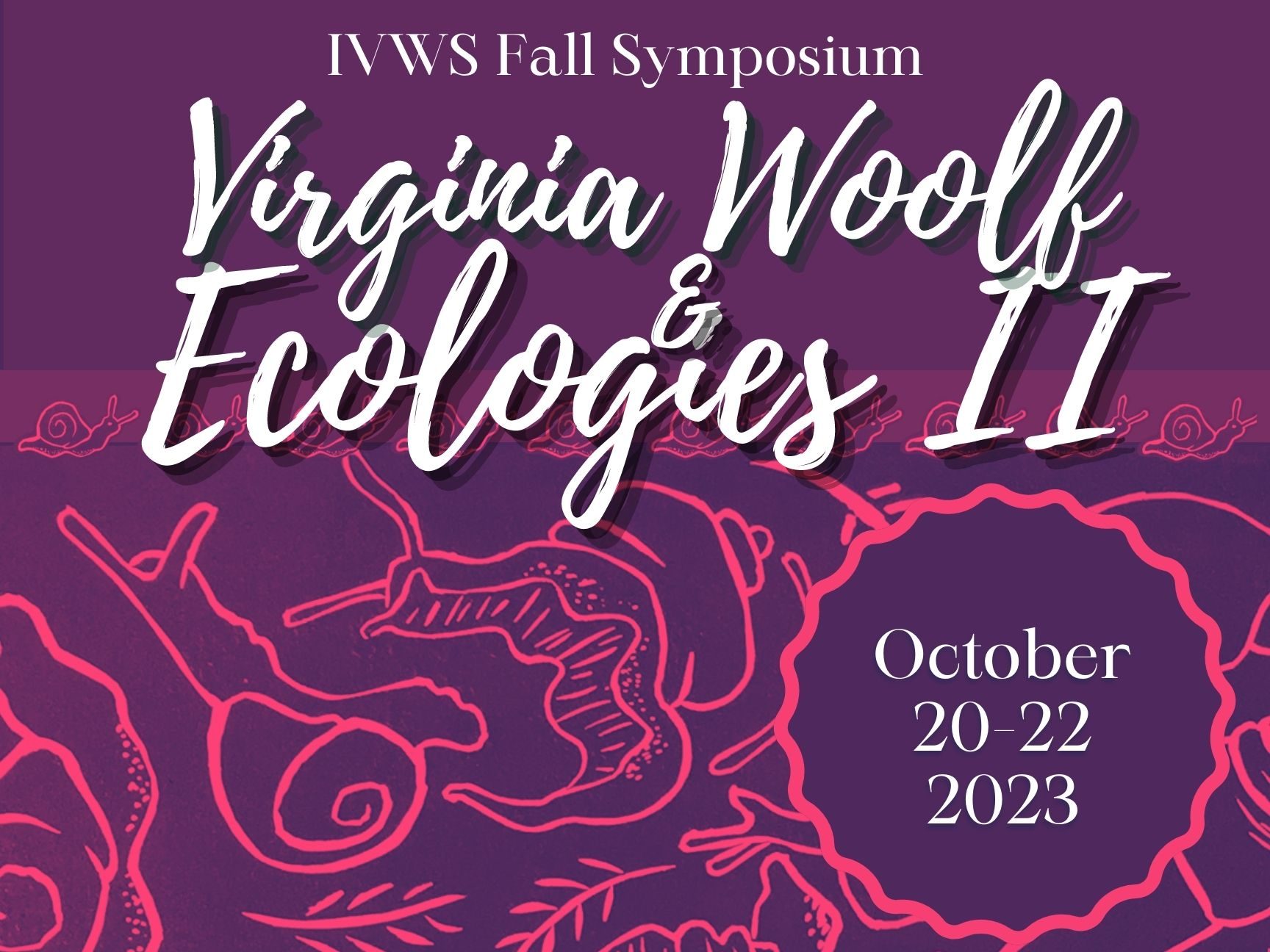
Get ready for Woolf and Ecologies II! This virtual Fall Symposium will be held on Zoom Oct 20-22 to give those who did not have the opportunity to travel to Ft. Myers, Fla., for the in-person conference the chance to present their work.

It will be hosted by the International Virginia Woolf Society in conjunction with its annual Fall Lecture and in collaboration with the organizers of the 2023 Woolf Conference that took place at Florida Gulf Coast University June 8-11.

The Fall Symposium will extend the theme of the 32nd Annual International Conference on Virginia Woolf: Woolf and Ecologies. Derek Ryan will deliver the 2023 IVWS Fall Lecture, which will double as the symposium’s plenary address.

Call for papers

Those who did not present at the in-person conference in June are invited to submit a 250-word abstract to the Fall Symposium by July 31. Organizers welcome proposals from scholars, students, artists, and common readers of all backgrounds and disciplines.

The Fall Symposium seeks to foster conversations about a wide range of ecologically relevant topics. Proposals may address ecological concerns in or illuminated by Woolf’s work, but they might alternately explore artistic, social, political, economic, racial, de-colonial, anti-ableist, and/or queer ecologies, among others, in or alongside Woolf’s novels, essays, letters, or diaries.

Papers on members of the Bloomsbury Group and other associates of Virginia Woolf in relation to the conference theme are also encouraged.

Questions?

Please send inquiries to Laci Mattison and Shilo McGiff at woolfecologies@gmail.com.

Note: this virtual event is planned to increase access for those unable to travel for/present their work at the in-person conference at Florida Gulf Coast University earlier this month. Those who presented at this month’s conference, are urged to support their colleagues by attending the symposium on Zoom.

Submit for publication

As in previous years, presenters will have the opportunity to submit their work for publication in the selected papers series. Send queries to Shilo McGiff and Laci Mattison at  woolfecologies@gmail.com.

Read Full Post »

IVWS Logo

The International Virginia Woolf Society announces the Annual Undergraduate Essay Competition in honor of Virginia Woolf and in memory of Angelica Garnett, writer, artist, and daughter of Woolf’s sister, Vanessa Bell.

Undergraduate essays can be on any topic pertaining to the writings of Virginia Woolf. Essays should be between 2,000 and 2,500 words in length, including notes and works cited, with an original title of the entrant’s choosing.

Essays will be judged by the society’s officers: Benjamin Hagen (President); Amanda Golden (Vice-President); Susan Wegener (Secretary-Treasurer); and Catherine Hollis (Historian-Bibliographer). The winner will receive $400 and have the essay published in a subsequent issue of the Virginia Woolf Miscellany.

To submit an essay, please fill out the entry form, then send your essay to Benjamin D. Hagen at Benjamin.Hagen@usd.edu.

All entries must be received by 30 June 2023.

Read Full Post »

Virginia Woolf asked questions of the moment: How can we prevent war? What does a woman need to be able to write fiction? Now, with the death toll from the Feb. 6 earthquake that struck Turkey and Syria currently at 36,000 and climbing, the Woolf community asks the question of this moment: How can we help?

Ben Hagen, president of the International Virginia Woolf Society, reached out to Mine Özyurt Kılıç of Turkey, who is involved in the formation of the non-profit Virginia Woolf Studies in Turkey Initiative, to ask just that question.

She shared information provided by two colleagues, and we have copied it below. It includes frightening facts about the 7.8-magnitude devastating quake, along with information about how to help.

Facts about the earthquake

  • The earthquake that hit the region was equal to 130 atomic bombs.
  • It hit 10 major cities in Türkiye and Syria.
  • Nearly 7,000 buildings have been confirmed to have collapsed.
  • The area affected by the Turkish/Syrian earthquake is the size of the entire United Kingdom.
  • There has never been another earthquake that affected such a large area in history.
  • The biggest reason for the destruction is that the earthquake was very close to the surface and therefore the damage to infrastructure such as roads, bridges and airports is very high.

How we can help

According to Mine’s colleagues, the best way to support people in the devastated areas is to donate to the following organizations:

AHBAP is a Turkish organization that describes itself as a “cooperation movement that works with value systems based on solidarity, sharing, and belonging.” The network provides “all kinds of aid” to those in need, including cash transfers and in-kind support. Through their support, they seek “to create contemporary and sustainable networks of cooperation and solidarity” that use new models that ensure they “protect local cultures.” Donations can be sent through their website as well. The organization has also created and will update a list of community centers and businesses that have opened their doors to those seeking refuge.

AFAD is Türkiye’s official disaster and emergency management authority.
This website has some useful information as well: https://www.afetbilgi.com/. Be sure to click on the small box in the middle near the top to choose your language preference.

Please share this information with your personal and academic circles/groups/networks as much as possible to help the victims! Please raise awareness on social media!

Read Full Post »

« Newer Posts - Older Posts »