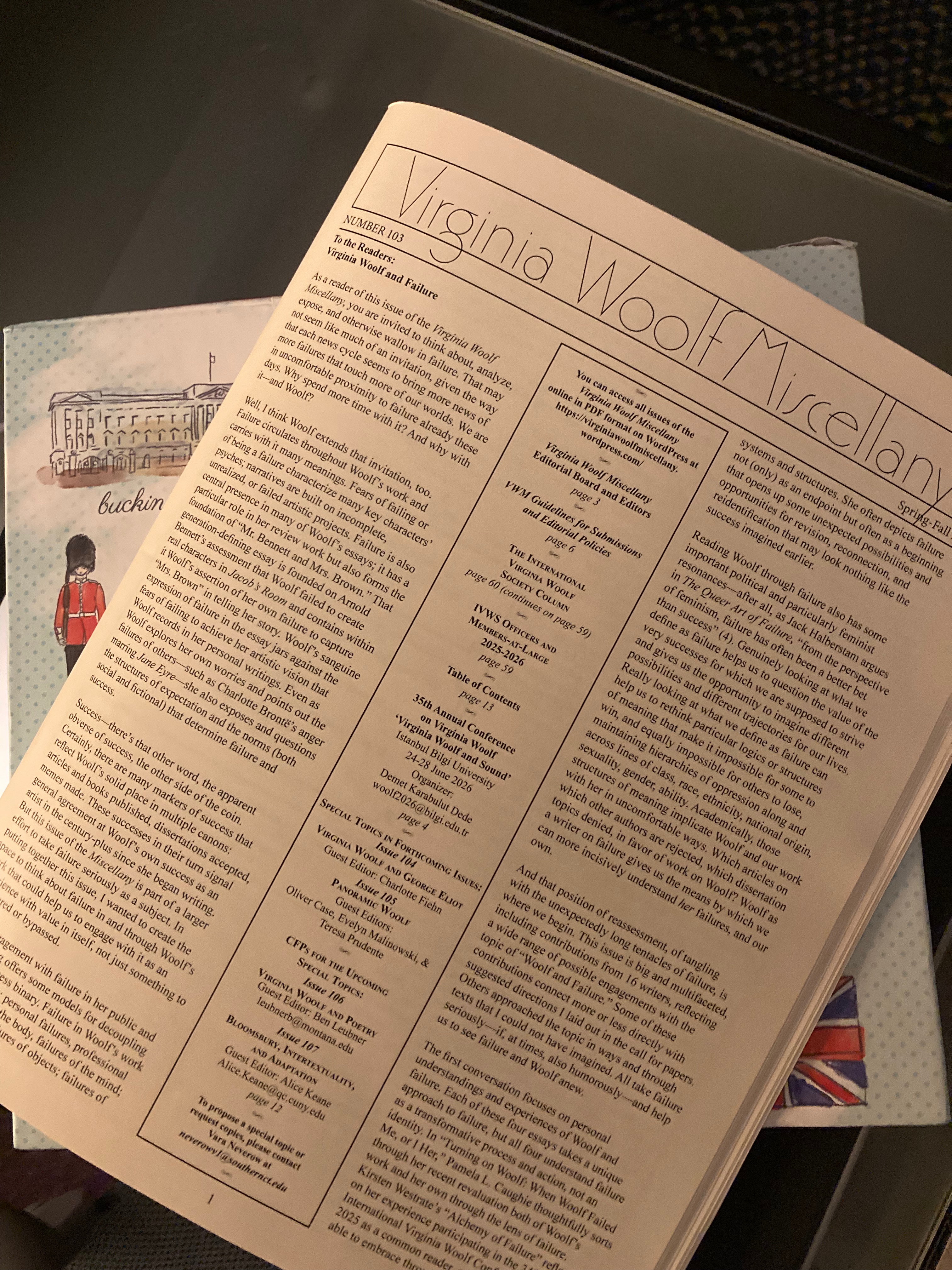
I had never thought about Virginia Woolf and failure until last week when I received the Spring-Fall 2025 issue of the Virginia Woolf Miscellany. To me, Virginia Woolf had always been synonymous with success.
But this new issue invites readers “to think about, analyze, expose, and otherwise wallow in failure” — and asserts that “[f]ailure circulates throughout Woolf’s work and carries with it many meanings.”
In her introduction to the issue, Number 103, editor Mary Wilson argues that “Woolf’s engagement with failure in her public and private writing offers some models for decoupling that failure/success binary.”
The 60-page issue includes 14 thought provoking articles and two poems on the topic.
Here are just a few:
“Turning on Woolf: When Woolf Failed Me, or I Her” by Pamela L. Caughie
“Woolf’s Variations on Failure” by Savina Stevanato
“The Aesthetics and Polemics of Failure: Virginia Woolf as Novelist and Feminist” by Harish Trivedi
“Failure Allure,” a poem by Cecilia Servatius
This issue is available online, along with Miscellany back issues. Find out more about joining the International Virginia Woolf Society, publisher of the Miscellany.
How to contribute
If you want to contribute an article or a poem or an artwork, are looking for an article published in the Miscellany, need to access a print or online copy of an issue, want to acquire issues of the publication to use in a classroom, or have any questions about the it, please contact Vara Neverow at neverowv@southernct.edu.
A call for papers for a special issue of the Virginia Woolf Miscellany #103 has gone out on the topic of “Woolf and Failure.”
For this special issue of the Virginia Woolf Miscellany, readers and writers are invited to think about, analyze, expose, and otherwise wallow in failure.
Failure circulates throughout Woolf’s work, and carries with it many meanings. Fears of failing or of being a failure characterize many key characters’ psyches; narratives are built on incomplete, unrealized, or failed artistic projects.
Failure is also a central presence in many of Woolf’s essays; it has a particular role in her review work, but also forms the foundation of “Mr. Bennett and Mrs. Brown.”
That generation-defining essay is founded on Arnold Bennett’s assessment that Woolf failed to create real characters in Jacob’s Room, and contains within it Woolf’s assertion of her own failure to capture “Mrs. Brown” in telling her story.
That sanguine expression of failure in the essay jars against the fears of failing to achieve her artistic vision that Woolf records in her personal writings.
Even as Woolf explores her own worries and points out the failures of others—such as Charlotte Brontë’s anger marring Jane Eyre—she also exposes and questions the structures of expectation and the norms (both social and fictional) that determine failure and success.
Our own failures add meaning
While we can readily credit our later successes to lessons learned from earlier failures, we often experience failure in less linear and more cyclical ways. Failure surfaces at different points in our lives and work, and fears of failing and the risks involved in achieving anything other than success recur in sometimes unexpected situations.
Failure is ordinary, not extraordinary—and when we recognize failure’s ordinariness, its significance in Woolf’s work may take on new meaning.
And yet failure need not be a bummer — nor need this special issue. As Jack Halberstam argues in The Queer Art of Failure, “under certain circumstances failing, losing, forgetting, unmaking, undoing, unbecoming, not knowing may in fact offer more creative, more cooperative, more surprising ways of being in the world” (2-3).
In what ways might Woolf’s work offer examples of this mode of failing or this way of understanding what failure offers?
Lastly, since each of us contends with failure in our own lives in and out of the classroom, this special issue also welcomes personal reflections on the experience of failure. Where do our understandings of failure intersect with our work with Woolf? How have our failures shaped us, and continue to shape our scholarship and teaching?
Possible approaches might include:
Defining failure in or through Woolf
Representations of failure in Woolf’s novels, short stories, and essays
Failure in Woolf’s personal writings
Failure as action (failing) or identity (being a failure)
Reading Woolf’s work through theories of failure, such as Jack Halberstam’s The Queer Art of Failure
Woolfian aesthetics of failure
Failures of imagination and/or execution
Political, social, and ethical failures
Failed identities
Examinations of Woolf’s failed projects
Woolf’s assessments of her own failures and those of others
Woolf and other women writers: does Woolf’s success at infiltrating the canon mean others’ failure?
Our own experiences of failure as students, scholars, and teachers of/with Woolf
How to submit
Please submit essays of 2,500 words or fewer to Mary Wilson at mwilson4@umassd.edu by Aug. 31, 2025.
The session will include a rich discussion (and celebration) of the Virginia Woolf Miscellany, which celebrated the major benchmark of its 100th issue last year. The discussion will include future and past editors of the publication, along with readers and newcomers.
The details
Event: Woolf Salon No. 27: “Virginia Woolf Miscellany at 100″
Hosts: Vara Neverow and Salon Conspirators Date: Friday, May 10 Time: 2–4 p.m. EDT (New York) / 11 a.m.–1 p.m. PDT (Los Angeles) / 3–5 p.m. Brasilia / 7–9 p.m. BST (London) / 8–10 p.m. CEST (Paris) / 9 –11 p.m. Ankara / Sat 3–5 a.m. JST (Tokyo) / Sat 4 –6 a.m. AEST (Sydney) Where: On Zoom How: Contact woolfsalonproject@gmail.com to sign up for the email list and receive the Zoom link.
The readings
Organizers ask that folks read through issues 1 and 5 of the VWM, peruse the online archive as time allows, and come in with a favorite issue or cluster that has been meaningful to them, their scholarship, or their teaching. (Issue 101 is now available online.)
The Salon Conspirators — Benjamin Hagen, Shilo McGiff, Amy Smith, and Drew Shannon — began the Woolf Salon Project in July 2020 to provide opportunities for conversation and conviviality among Woolf-interested scholars, students, and common readers during and beyond the COVID-19 pandemic.
The Virginia Woolf Miscellany has issued a call for papers for Issue 102, the Spring 2024 issue, on the special topic of Twenty-First-Century Perspectives on Virginia Woolf: Feminisms, Genders, Politics, and Patriarchy.
Details are below.
Proposal guidelines and deadline
Send a proposal or an essay (an essay should not be much longer than 2,500 words, including the Works Cited section). The deadline for submissions is Jan. 31, 2024. Please send submissions to both: kimbec@bgsu.edu and neverowv1@southernct.edu
Editors
Guest Editor: Kimberly Coates at kimbec@bgsu.edu
Editor: Vara Neverow at everowv1@southernct.edu
About the topic
Activists in the twentieth-century Second-Wave feminist movement coined the phrase “the personal is political” to confront the patriarchy. Today, at least half a century later, the concept still applies, and one must still hold the patriarchy accountable for the marginalization and exploitation of cis-women and trans women alike.
About the call for papers
In this call for papers, the editors invite a variety of contributions that explore, define, and document a range of topics that cluster around Virginia Woolf’s own viewpoints and texts regarding patriarchy and its impact on girls and women (whether cis-born or trans). These approaches can align or clash with differing contemporary sexual and gender-based politics.
Contributions can be in the form of essays, poetry, and artwork. Note: the electronic edition of the issue will include color, but the print version will be in black-and- white format.
Possible questions to address
The editors hope to examine the evolution of this complex historical moment from multiple perspectives. While the editors offer a range of rhetorical questions below, they also encourage contributors to feel free to craft their own approaches.
How do Woolf’s works intersect with reproductive rights; reproductive justice; girls, women’s and trans healthcare; and the representation, construction, and control of “female” bodies whether cis-born or other?
How do Woolf’s political insights play into the current opportunities and constraints of women’s rights in the workplace, in professions, and in labor?
How does Woolf’s advocacy for women’s financial stability and independence intersect with twenty-first variants of exclusion and inclusion of feminisms and womanism?
How can Kimberlé Williams Crenshaw’s diagramming of intersectionality, discrimination, privilege, and marginalization—for example, ablism, ageism, class, gender and sex, race/ethnicity/nationality, religion, physical appearance including skin-tone—be applied to Woolf’s own advocacy?
Placing Woolf in 21st-century context
The editors envision articles that might place Woolf in the context of creative twenty-first-century conversations with feminist writers and advocates from Asia, the Middle East, Eastern Europe, Africa, and the Americas.
They also welcome feminist perspectives from the late-nineteenth through to the mid-twentieth century. For example, such British and Western European activists as Josephine Butler, Annie Besant, Sylvia Pankhurst, Millicent Fawcett, Ray Strachey, and Simone de Beauvoir might provide relevant perspectives—but there are many other approaches.
Woolf’s own critical reception as feminist and activist evolved at the same time that Second-Wave advocates, scholars, and novelists, primarily in the United States and Canada, were expressing their views and offering their insights to a feminist readership.
The editors are interested in essays that address how these types of perspectives might influence twenty-first century feminisms. Twenty-first century works by such feminist advocates as Roxane Gay, Sara Ahmed, and Chimamanda Ngozi Adichie are highly relevant, as are essays that focus on the work of feminist activists in such fields as politics and climate change and that intersect with elements in Woolf’s own oeuvre.
Evolution of intersections and Woolf’s reception
Over the decades, generations of feminists (we are now in the Fifth Wave) have addressed the increasingly complex perceptions associated with the evolving intersections of sexuality and gender, while also tackling the politics of patriarchy.
Similarly, Woolf’s reception has become ever more intricate and more global as patriarchy has continued to encroach on the lives of women and girls, whether cis-born or trans.
Multiple approaches welcome
The editors welcome multiple approaches. Contributions can be confrontational and passionate but must also speak to collaborative inclusive efforts.
The editors hope that submissions will feature methods, solutions, and possibilities that are centered in Woolf studies and function as counterpoints to the escalating patriarchal and political attacks on feminism, on women and girls, and on trans and queer people in the twenty-first century.
The latest installment, Issue 98, is now online. It features the special topic “The First Thirty Annual (International) Conferences on Virginia Woolf,” edited by AnneMarie Bantzinger.
The collection, solicited in 2019, offers a collage of reminiscences and memories that evoke the conference experiences from multiple perspectives, those of organizers and participants.
Among them is one I wrote about the 2009 conference in New York City. I’m sharing it here.
Woolf and the City: Wow!
For a girl born in Brooklyn, transplanted to Ohio at the age of three, and engaged in a longtime love affair with both Virginia Woolf and New York, could there be anything better than a Woolf conference in New York City? I think not.
Conference organizer Anne Fernald and Megan Branch, Fordham student, at Woolf and the City
And that is why “Wow!” was my immediate reaction to Woolf and the City, the 19th Annual International Conference on Virginia Woolf. Ten years later that is still my emotional response when I think of that 2009 event, which is why I chose the New York City conference as my personal hands-down favorite among the ten Woolf conferences I have attended.
Held June 4-7 at Fordham University on Manhattan’s Upper West Side and organized by Anne Fernald, the conference was the second I had attended. But it was the first one I wrote about on Blogging Woolf, the site I created in July of 2007. Now, those blog posts, including one aptly titled “In the aftermath of Woolf and the City, one word — Wow!” help me recall the high points of the conference I described as “dynamite.”
Notable scholars, authors, readers
It featured 50 panels, attracted 200 Woolf scholars and common readers from around the globe, and introduced me to notable authors I never dreamed I would meet.
Ruth Gruber at Woolf and the City
One was Dr. Ruth Gruber, who died in 2016. Ninety-seven at the time of the conference, she was known as a journalist, photographer, and the author of Virginia Woolf: The Will to Create as a Woman (1935).
She shared fascinating stories of her 1930s experiences as a journalist who visited the Soviet Arctic and a writer who met Virginia and Leonard Woolf in their Tavistock Square flat.
I remember chatting with this redhead curbside as she patiently waited for the cab that would take her home.
Novel writer and keynote speakers
Susan Sellers
Another was Susan Sellers, author of Vanessa and Virginia, the novel based on the relationship between sisters Vanessa Bell and Virginia Woolf, which was receiving rave reviews in the US at the time. I recall her graciousness as she signed books and chatted with readers.
Others I listened to, but did not meet, included keynote speaker Rebecca Solnit, a prolific author whose work is so timely and compelling today, and Tamar Katz of Brown University who spoke about the importance of “pausing and waiting” in life and in Woolf.
From a walking stick to rock music
What else struck my fancy? Here’s the list:
A visit to the Berg Collection at the New York Public Library, where we were treated to a private viewing of pieces in the Virginia Woolf collection, including the walking stick rescued from the River Ouse after her death. Being there felt more sacred than church.
A performance of the 2004 play Vita and Virginia, written by Dame Eileen Atkins and directed by Matthew Maguire, director of Fordham’s theatre program.
A performance that combined rock-out music from an L.A. band called Princeton with dance from the Stephen Pelton Dance Theatre as the group performed cuts from its four-song album “Bloomsbury” based on the lives of Virginia and Leonard Woolf, John Maynard Keynes, and Lytton Strachey.