What: A free online talk on “The Surreal Real: Proust, Woolf, and World Cinema,” as part of the Woolf Seminars series of the Virginia Woolf Society Turkey. Who: Delia Ungurenau is associate director of Harvard’s Institute for World Literature and associate professor of literary theory in the Department of Literary Studies at the University of Bucharest. She is the author of From Paris to Tlôn: Surrealism as World Literature and The Poetics of Apocalypse: The Cultural War in Romanian Literary Magazines, 1944-1947 When: Friday, Dec. 8, 6-8 pm Turkey time (10 a.m. – noon EST). Please check your local time. Cost: Free Registration: Registration is free at Eventbrite.
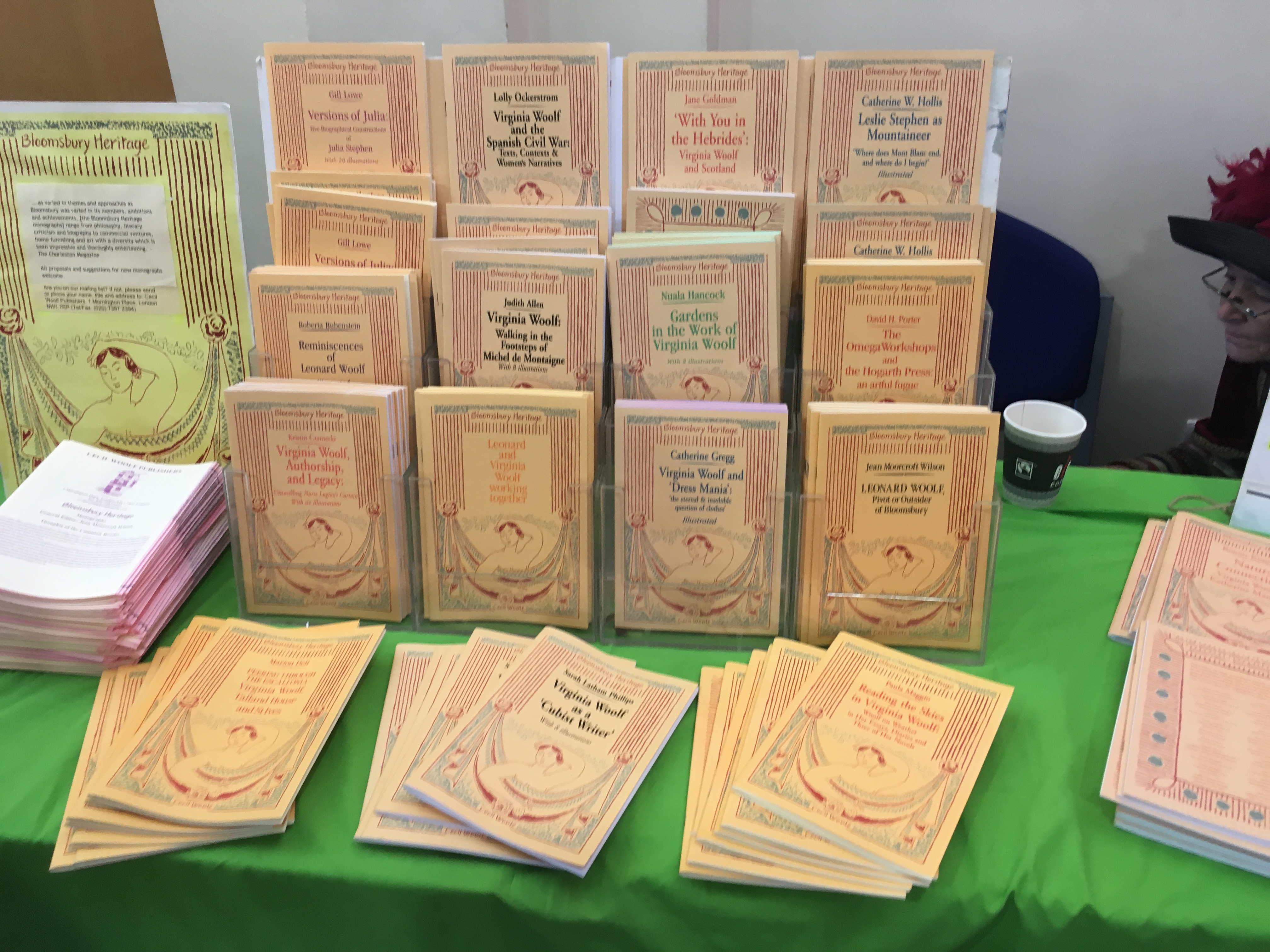
Some of the monographs in the Bloomsbury Heritage Series from Cecil Woolf Publishers. The monograph by Catherine Hollis, “Leslie Stephen as Mountaineer: Where does Mont Blanc end, and where do I begin?”, was published in 2010.
Editor’s Note: As of Feb. 19, the deadline for the call for papers has been extended to March 31.
The call for papers has gone out for the first-ever conference on Virginia Woolf’s father, Leslie Stephen, which will be held at Université Sorbonne Nouvelle in Paris on Oct. 24-25, 2024. The conference title is “Leslie Stephen: Thinking With and Against His Time International Conference.”
Abstracts of about 300 words, for 25-minute papers in English, together with a short (100-word) author biography, should be sent to the organizers by Jan. 31, 2024, at: leslie.stephen.conference@gmail.com.
A selection of peer-reviewed articles based on papers given at the conference will be collected for publication. In case of difficulties tracing Stephen’s works, please contact the organizers, who will be happy to share links and resources.
Organizers are Claire Davison (Université Sorbonne Nouvelle, Paris); Isabelle Gadoin (Université Sorbonne Nouvelle, Paris); and Marie Laniel (Université de Picardie, Amiens).
More details
PRISMES – EA 4398
Langues, Textes, Arts et Cultures du Monde Anglophone
CORPUS – UR-UPJV 4295
Conflits, Représentations et Dialogues dans l’Univers Anglo-Saxon
SEW – Société d’Études Woolfiennes
Confirmed keynote speakers
Dr. Jane Potter (Oxford Brookes University)
Dr. Trudi Tate (Clare Hall, University of Cambridge)
Call for papers
Early advocate of evolutionism, one of the first openly declared agnostics, editor of the Cornhill Magazine, pioneering mountaineer, moral philosopher, founder and general editor of the DNB: there are so many more facets to Leslie Stephen (1832-1904) than those recorded by his daughter Virginia Woolf, who memorably paid tribute to his “strong,” “healthy out of door, moor striding mind”. By unfolding all the contradictions and paradoxes of the character, this first international conference on Leslie Stephen means to reclaim the full complexity of his thought and legacy.
Thinking with and against his time, Stephen held a key position at the heart of the Victorian literary sceneand was an impressively prolific writer, profoundly engaged with the religious, philosophical and social debates of his age. A highly respected journalist and critic, he edited the Cornhill Magazine from 1871 to 1882, publishing works by George Meredith, Thomas Hardy, John Addington Symonds, Henry James and R.L. Stevenson, and was the author of hundreds of essays, published over the course of forty years in periodicals, such as the Fortnightly Review, Fraser’s Magazine, Macmillan’s Magazine, Mind, the National Review, the Nineteenth Century, the Saturday Review or the Pall Mall Gazette, a vast oeuvre now finally accessible thanks to online databases.
His devotion to knowledge and integrity were such that he preferred to break with the academic world of Cambridge rather than compromise with the Church. Heir to the Clapham Sect, Stephen engaged with the theological debates of his time to the point of gradually and publicly embracing agnosticism, a form of radicalism that coexisted from then on with forms of traditionalism.
His own prolific output bears witness to his encyclopaedic mind and his boundless curiosity for all the key issues of the day, however polemical: the anti-slavery movement, agnosticism, educational and social reform… Both a man of his time and a pioneer, Stephen explored new epistemological modes in keeping with the expanding frontiers of his age, while remaining profoundly anchored in some of the values and hierarchies of the day.
The Dictionary of National Biography (DNB), his life’s work, and one of his most ambitious projects, is the finest example of his desire to define new modes of classification and new forms of expression for the expanding knowledge of his time. Breaking with the established narratives of the past, he devised a new approach to writing the biography of the nation, doing away with the grandiose tradition of commemoration. In its place, he developed a more archaeological approach, delving into the past and collating the life stories of all those who helped shape the evolution of the country.
The same pioneering spirit stoked his passion for the Alps and mountaineering, in which he proved as much a trailblazer as he did in intellectual life. It is this conquering spirit that his close friend Thomas Hardy immortalized in his poem “The Schreckhorn, With Thoughts of Leslie Stephen” (1897), which extolled his will to “venture life and limb” as well as the “quaint glooms” of his personality, when paying tribute to Stephen as the first man ever to ascend this mountain.
However daring and rigorous in his endeavours, Stephen was no less a direct heir to the Romantic tradition. An ardent poetry lover, he could quote vast swathes of the poetic canon, from Milton to Wordsworth, Tennyson and Arnold, and would rhythm both domestic life and mountaineering exploits with his recitations. Likewise, despite his allegiance to Victorian models of “Muscular Christianity”, and the manly world of clubs and fellowships, he would at times indulge in various forms of sentimentalism and melodramatic displays of emotion.
These are some of the contradictions that the participants to this conference are invited to explore. Similarly, his vast output deserves to be reconsidered through diverse critical paradigms, such as new materialist History, print culture studies, new sensory studies, phenomenology, affect studies and ethics, gender studies, health and disability studies.
We welcome contributions focusing on Leslie Stephen, but also on the following topics, connected with his life and times and shedding light on the larger context of his work:
Victorian encyclopaedism
Victorian periodicals, print culture, the publishing industry
Biography, the DNB, “hero-worship”
Stephen’s relations to Victorian sages and prophets
Letters, epistolarity, literary networks
Cambridge, academia, education and university reform
Gentlemen’s clubs, sociability
18th century philosophy and literature, the Enlightenment
Utilitarianism, Science, Evolutionism
The Clapham Sect, Agnosticism, Scepticism
War, the anti-slavery movement
Morality, the “science of ethics”
Mountaineering, athletics, walking, nature and travel writing
Memory, elegy, mourning, the Mausoleum Book, Virginia Woolf & Leslie Stephen
The Virginia Woolf Miscellany has issued a call for papers for Issue 102, the Spring 2024 issue, on the special topic of Twenty-First-Century Perspectives on Virginia Woolf: Feminisms, Genders, Politics, and Patriarchy.
Details are below.
Proposal guidelines and deadline
Send a proposal or an essay (an essay should not be much longer than 2,500 words, including the Works Cited section). The deadline for submissions is Jan. 31, 2024. Please send submissions to both: kimbec@bgsu.edu and neverowv1@southernct.edu
Editors
Guest Editor: Kimberly Coates at kimbec@bgsu.edu
Editor: Vara Neverow at everowv1@southernct.edu
About the topic
Activists in the twentieth-century Second-Wave feminist movement coined the phrase “the personal is political” to confront the patriarchy. Today, at least half a century later, the concept still applies, and one must still hold the patriarchy accountable for the marginalization and exploitation of cis-women and trans women alike.
About the call for papers
In this call for papers, the editors invite a variety of contributions that explore, define, and document a range of topics that cluster around Virginia Woolf’s own viewpoints and texts regarding patriarchy and its impact on girls and women (whether cis-born or trans). These approaches can align or clash with differing contemporary sexual and gender-based politics.
Contributions can be in the form of essays, poetry, and artwork. Note: the electronic edition of the issue will include color, but the print version will be in black-and- white format.
Possible questions to address
The editors hope to examine the evolution of this complex historical moment from multiple perspectives. While the editors offer a range of rhetorical questions below, they also encourage contributors to feel free to craft their own approaches.
How do Woolf’s works intersect with reproductive rights; reproductive justice; girls, women’s and trans healthcare; and the representation, construction, and control of “female” bodies whether cis-born or other?
How do Woolf’s political insights play into the current opportunities and constraints of women’s rights in the workplace, in professions, and in labor?
How does Woolf’s advocacy for women’s financial stability and independence intersect with twenty-first variants of exclusion and inclusion of feminisms and womanism?
How can Kimberlé Williams Crenshaw’s diagramming of intersectionality, discrimination, privilege, and marginalization—for example, ablism, ageism, class, gender and sex, race/ethnicity/nationality, religion, physical appearance including skin-tone—be applied to Woolf’s own advocacy?
Placing Woolf in 21st-century context
The editors envision articles that might place Woolf in the context of creative twenty-first-century conversations with feminist writers and advocates from Asia, the Middle East, Eastern Europe, Africa, and the Americas.
They also welcome feminist perspectives from the late-nineteenth through to the mid-twentieth century. For example, such British and Western European activists as Josephine Butler, Annie Besant, Sylvia Pankhurst, Millicent Fawcett, Ray Strachey, and Simone de Beauvoir might provide relevant perspectives—but there are many other approaches.
Woolf’s own critical reception as feminist and activist evolved at the same time that Second-Wave advocates, scholars, and novelists, primarily in the United States and Canada, were expressing their views and offering their insights to a feminist readership.
The editors are interested in essays that address how these types of perspectives might influence twenty-first century feminisms. Twenty-first century works by such feminist advocates as Roxane Gay, Sara Ahmed, and Chimamanda Ngozi Adichie are highly relevant, as are essays that focus on the work of feminist activists in such fields as politics and climate change and that intersect with elements in Woolf’s own oeuvre.
Evolution of intersections and Woolf’s reception
Over the decades, generations of feminists (we are now in the Fifth Wave) have addressed the increasingly complex perceptions associated with the evolving intersections of sexuality and gender, while also tackling the politics of patriarchy.
Similarly, Woolf’s reception has become ever more intricate and more global as patriarchy has continued to encroach on the lives of women and girls, whether cis-born or trans.
Multiple approaches welcome
The editors welcome multiple approaches. Contributions can be confrontational and passionate but must also speak to collaborative inclusive efforts.
The editors hope that submissions will feature methods, solutions, and possibilities that are centered in Woolf studies and function as counterpoints to the escalating patriarchal and political attacks on feminism, on women and girls, and on trans and queer people in the twenty-first century.
If you are a member of the Virginia Woolf Society of Great Britain, you are invited to a FREE members only online Christmas celebration that includes an evening of readings about Christmas and winter from Virginia Woolf and the Bloomsbury group.
“A Virginia Woolf Christmas – Monks House Welcome Home” design by renowned collage artist Amanda White
What: An evening of five-minute readings by society members that will focus on writings by Virginia Woolf and the Bloomsbury group that discuss Christmas and or winter. When: Wednesday, Dec. 6, 5.30 p.m. GMT How: On Zoom. Members will receive a Zoom link, meeting ID and passcode.
Join the Virginia Woolf Society of Great Britain
To join the society and have access to the Dec. 6 Zoom event, visit the group’s membership page. Members receive:
FREE Virginia Woolf Bulletin three times a year, containing articles, reviews and previously unpublished material by Woolf herself (normally £7 each)
Discount and priority notice for Birthday Lecture: this is an annual talk by a Woolf scholar or author, held on the Saturday nearest to 25 January
FREE regular email updates, with information and news of upcoming Woolf events
Discount and priority notice for VWSGB events, e.g. day conferences; study weekends, talks, visits; guided walks in an area connected with Woolf
Member-only online talks: live talks accessed by web link (small additional charge)
FREE online group events: networking events and readings for members only.
Virginia Woolf wrote hundreds of essays during her lifetime. The total varies from “nearly 600” (Fernald 160) to “640,” (Rigel Daughtery 9) so it can be difficult to locate just the right essay when needed. For that reason, sometimes a slim collection of Virginia Woolf essays that focus on a specific topic is just the thing.
Here are two.
On freedom
The first is part of a 27-volume Vintage Mini collection, a Vintage Classic published by Penguin/Random House. Titled Liberty, it includes selections from A Room of One’s Own (1929), The Waves (1931), and the essays “Street Haunting” and “How Should One Read a Book.”
Here begins the freedom of the mind, or rather the possibility that in the course of time the mind will be free to write what it likes – jacket quote from Liberty (2018)
On the visual arts
The second is the twentieth volume in the ekphrasis series published by David Zwirner Books in 2021 and is a collection of Woolf’s writings on the visual arts.
Titled Oh, to Be a Painter!, the volume begins with an introduction by Claudia Tobin and includes Woolf’s longest essay on painting, “Walter Sickert: A Conversation” (1934), alongside shorter essays and reviews, including “Pictures and Portraits” (1920) and “Pictures” (1925).
References:
Fernald, Anne E. “A Feminist Public Sphere? Virginia Woolf’s Revisions of the Eighteenth Century.” Feminist Studies 31:1 (2005): 158-182.