Virginia Woolf’s short story “The Mark on the Wall,” published in 1917, was one of the first two stories printed and published by Virginia and her husband Leonard when they started the Hogarth Press. A new experimental short film, now available online, brings her first published story to life.
Anderson Wright’s evocative and experimental short film is described as capturing the essence of Woolf’s stream-of-consciousness narrative, in which a seemingly insignificant mark on the wall triggers the exploration of memory, identity, and the passage of time.
I watched it and found it hauntingly beautiful, with the final words of the film echoing Woolf’s own, minus her words about war.
If you have three minutes and forty-four seconds at your disposal, you can watch it, too.
A still from the documentary “Orlando, My Political Biography”
“The contemporary world is full of Orlandos who are changing the course of history,” says Spanish-born philosopher turned director Paul B. Preciado.
“Orlando, My Political Biography,” his documentary adaptation of Virginia Woolf’s 1928 pseudo-biography Orlando, premiered at the Berlin International Film Festival earlier this year — and took home four prizes — while interrogating the relevance of Woolf’s Orlando in the process.
The film is described as a “cinematic essay in conversation with Woolf’s 1928 satiric fantasy Orlando: A Biography, as well as “a personal essay, historical analysis, and social manifesto.” Preciado, who first read Woolf’s novel at the age of 15, also describes it as “my own biography.”
In it, Preciado casts a diverse cross-section of more than 20 trans and non-binary individuals in the role of Orlando as they interpret scenes from the novel, weaving their own stories of identity and transition into Woolf’s narrative.
Choosing the cast
Preciado explains how he chose the cast this way: “The way I selected the other participants was by trying to understand if they could speak the language of Virginia Woolf. This, to me, was the most difficult aspect of any Orlando performance, because Virginia Woolf’s language is so sophisticated, so crystalized and sparkling, that it’s hard to speak her words without sounding phony or ridiculous.”
The documentary enlists a cast that includes well-known French LGBTQ+ figures to share the role of the novel’s eponymous hero as they perform interpretations of scenes from the novel, weaving into Woolf’s narrative their own stories of identity and transition.
It also includes footage of singer and trans pioneer Christine Jorgensen and fiery advocate Sylvia Rivera to help reflect the history of queer resistance.
Choosing the scenes
Preciado explains how scenes from Woolf’s novel were chosen for the film: “Some of the scenes were chosen by the Orlandos through the reading sessions . . . some Orlandos lobbied for certain scenes in the novel to be included in the film, and we went with those.
“The scene of Orlando returning to England by ship after having transformed into a woman, I really wanted to adapt this scene properly since it’s one of the crucial scenes in the novel. But it became so difficult. We went to the north of France and obtained a small boat that we had to pretend was bigger than it was–it was extremely expensive, and I had very little money with which to make the film. Very quickly we realized that this scene was impossible, that it wasn’t going to work. So we decided to make a mock-up of a boat in a studio and see how that would look.
“Many of the scenes I had in mind–especially since Orlando is a book of adventures and travel and changing epochs and countries–couldn’t be rendered on film as they are in the novel.
“Another example was a scene in the desert that became difficult to pull off since I had to find a desert that was nearby–and there are no deserts close to France!
“At a certain point I realized that faithfully adapting such scenes was less important than capturing the language of Virginia Woolf as well as representing the main adventure of the book, which is transitioning. It would be less about constructing the proper settings and decor and more of a spiritual or internal journey.”
Reappropriating Woolf’s words
“We discovered a freedom in reappropriating the words of Virginia Woolf,” Preciado said. “And not because Virginia Woolf said everything possible about transitioning, but because I think Virginia Woolf may have also been non-binary.
“In the last 40 to 50 years she’s been read–perhaps even over-read–as an exemplar of female and feminist authorship. But when re-reading her I realized she was very much at odds with what was supposed to be her own femininity. She was not comfortable with it and never aligned with it so much–she wasn’t even very interested in a naturalistic definition of feminism, at least as it existed during her lifetime.
“So I’ve thought, how interesting would it be if she was a non-binary author who lived during a time when the thought of being non-binary was impossible? That opened for me a very different way of reading Orlando. I’m not content with the politics of reading works through the identity of the author–for example, the idea that if the author isn’t trans then his or her book can’t be trans. Because maybe the author was able to recreate him, herself or themselves, in his, her or their own mind. The things we do exceed identity–otherwise if we have to be measured by our anatomy or whatever else then we’re going to be caged within the language of normative binaries. So that’s crucial for me.
“And when working on the readings of Orlando something started to happen–we brought Woolf into a contemporary, non-binary world, and a sort of joyful, amusing adventure began to occur in how we experienced her words, to the point where the cast members and their families would call me and say, ‘These readings are great, can we come back for more of them?’ Then it became clear to me that this was working, that we could use the language of Virginia Woolf against the language of normative identity.”
Now in theaters
Interested in seeing the film? Check this link for locations, dates, and tickets.
The way I see it, there are several connections between Greta Gerwig, her blockbuster film Barbie, and Virginia Woolf. Here we go:
One of Gerwig’s all-time favorite books is Woolf’s To the Lighthouse (1927). It is, she notes, “A classic for a reason. My mind was warped into a new shape by her prose, and it will never be the same again. The metaphysics she presents in the book are enacted in a way that allowed me to begin to understand that corner of philosophy.”
In A Room of One’s Own (1929), Woolf writes that “a woman must have a room of her own” in order to write fiction. In Barbie, all of the Barbies have entire dream houses of their own — and they find such ownership essential to their independent, feminist lifestyles.
An NPR story on the film includes this quote: “But Barbie could fend for herself. Like Nancy Drew, she drove her own roadster and lived in her own dream house — Virginia Woolf’s room of one’s own painted in pastels.”
From Second Wind Books comes this Facebook post that lists the similarities between Woolf and Barbie:
From Woolf scholar and novelist Maggie Humm comes this Twitter post:
Obligatory Barbie photo. Loved the artifice (like Asteroid City my last movie outing) pic.twitter.com/yzETjzw79J
Kabe Wilson pays tribute to archives, as well as Virginia Woolf’s 1927 novel To the Lighthouse, in a newly launched film based on his creative work with modernist archives this spring.
Wilson explains that “Looking for Virginia: An Artist’s Journey Through 100 Archives” “covers a series of archival quests about my childhood holidays, which then link up with Woolf and Bell’s own holidays, as well as their collaboration on To the Lighthouse itself, before developing into an elegy to all three,” Wilson explains.
The culmination of his residency at the Centre for Modernist Studies, the multi-media presentation centers around the story of the 10 paintings of Brighton and Sussex that Wilson produced during the 2020 lockdown period, and the exciting art history discovery that led to one of them becoming the cover image of a new edition of Woolf’s To the Lighthouse.
For his first Woolf-related project, Wilson rearranged Woolf’s words into his novella titled Olivia N’Gowfri – Of One Woman or So. Set 80 years after the publication of Woolf’s essay, it tells the story of a young woman’s radical challenge to literary conservatism in the elitist environment of the University of Cambridge.
He then turned his work into a piece of art, a 4 x 13-ft. sheet of paper displaying the novella’s 145 pages, with each word cut out, individually, from a copy of A Room of One’s Own, and reformed to duplicate the novella.
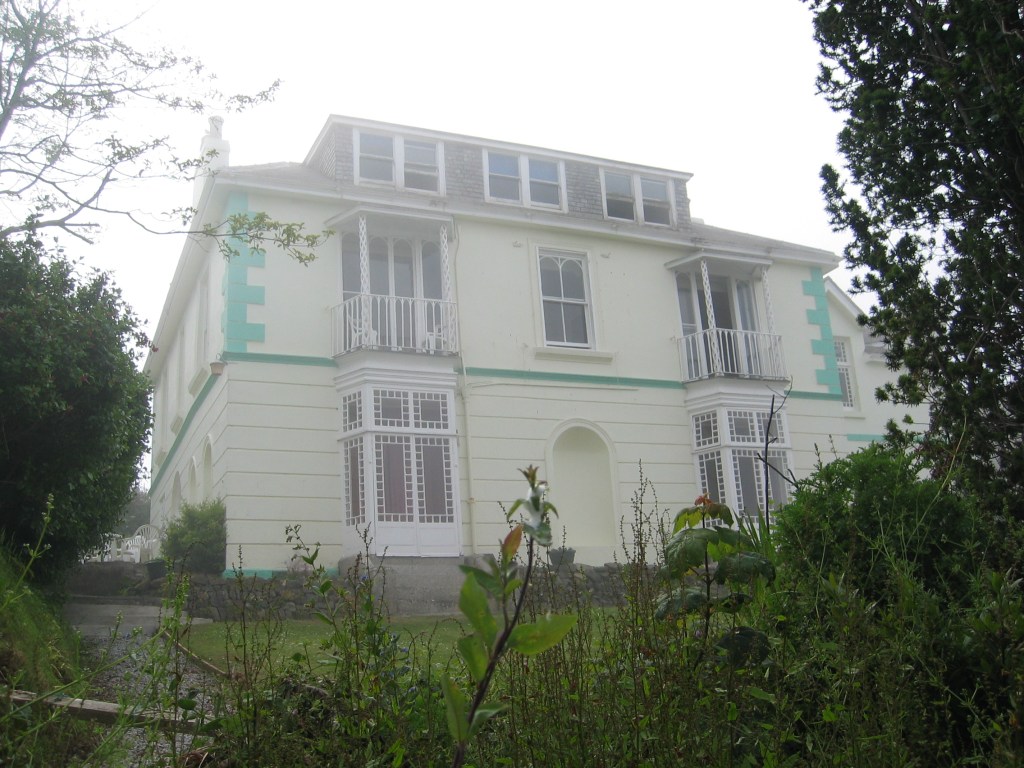
For anyone who reads and loves Virginia Woolf, St. Ives is a magical place. Take a trip back in time by viewing old footage of that Cornish town.
From the BBC iPlayer comes “Cornwall: This Fishing Life,” with series 2, episode 4, focusing on St. Ives. It includes old black and white film footage of the place where Woolf and the Stephen family spent their summers until she was 12.
Nineteen seconds of color film footage of St. Ives from Claude Friese-Greene’s The Open Road (1926) a fascinating social record of inter-war Britain. The St. Ives snippet below is available on the British Film Industry‘s YouTube Channel.
And just for fun, check out the video below of a model railroad version of St. Ives, circa the 1950s, created by a former St. Ives resident. In this eight-minute video, he adds his own memories, along with details about constructing the layout. Stuart Clarke of the Virginia Woolf Society of Great Britain shared this video and notes that we “may” be able to see Talland House at the 4-minute, 32-second mark.