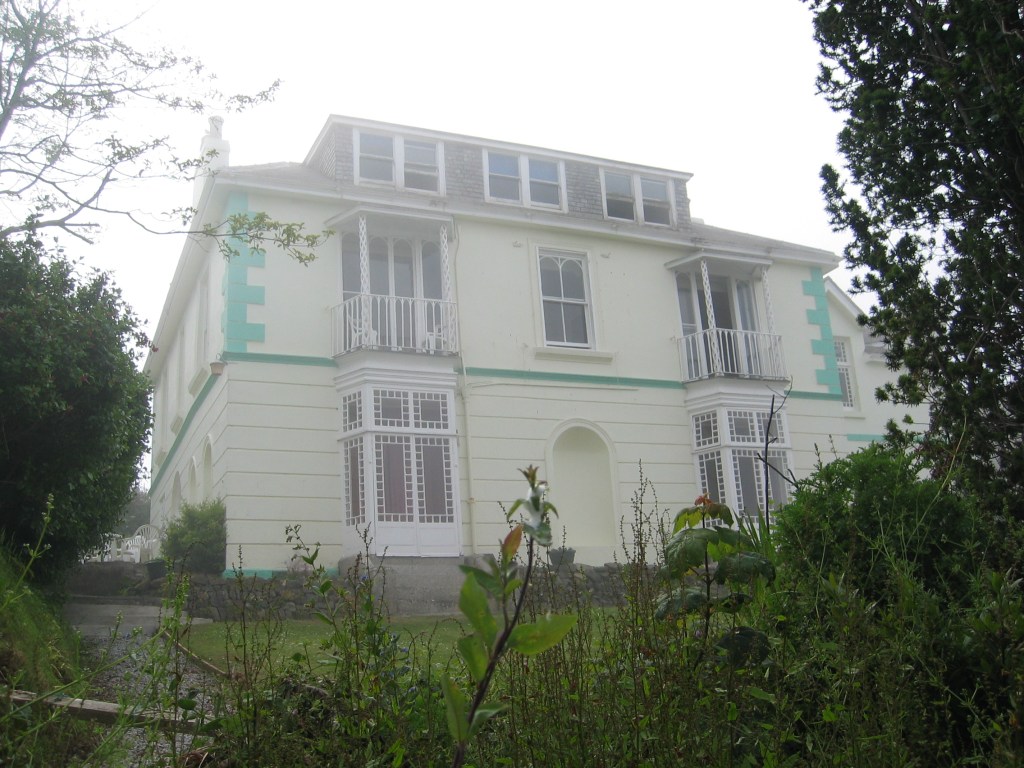
I’m all settled in to my spacious and comfy room of my own at Wolfson College at the University of Cambridge.
I took the train up from London a day earlier than necessary for the Literature Cambridge course on Virginia Woolf’s Gardens.
That means we had a bit of time to explore a small parcel of Cambridge, enjoy a lovely tea at Harriets Cafe and Tea Rooms, check in and collect our welcome packets from Trudi Tate and her crew, and — in typical American fashion — load up on some Cambridge swag.
King’s Parade in Cambridge is jammed with tourists, shoppers, and Cambridge folks on Sunday. We were among them. Trudi Tate and Rosa welcome Bee, a UK student and one of 23 in the Virginia Woolf’s Gardens course at Wolfson College at the University of Cambridge. Students, including Yuriko, found a table full of Literature Cambridge T-shirts. I bought a red one from Rosa. Suellen from the U.S. and Hans from the Netherlands take part in a Woolf-related conversation at Literature Cambridge check-in. Cambridge, Wolfson, and Lit Cambridge T-shirts. I had to have all three. The Classic Tea at Harrietts Cafe and Tearoom. The house blend is delicious. View from my room of my own in the Conference Center at Wolfson College at the University of Cambridge.
I will be there July 14-19 and will post about my experiences, as we learn about the importance of gardens to Woolf’s life and work, from her early story “Kew Gardens” (1917) to her last novel, Between the Acts (1941).
Other course readings include Jacob’s Room (1922), Mrs.Dalloway (1925), To the Lighthouse (1927), Orlando (1928) and A Room of One’s Own (1929).
Daily schedule
Each day of the fully booked course starts with a lecture presented by a leading scholar. A seminar or a Cambridge-style one-hour supervision (tutorial) for small groups of students will discuss the topic of the day, looking closely at that day’s text. Each will be taught by lecturers and post-docs from the University of Cambridge.
Lecturers include Suzanne Raitt, Gillian Beer, Alison Hennegan, Clare Walker Gore, Karina Jakubowicz, Oliver Goldstein, Trudi Tate, Kabe Wilson and Caroline Holmes.
Manuscript, excursions, and more
We will also get to view the manuscript of A Room of One’s Own held in Cambridge.
When the course ends, many of us will head out on two excursions — to Monk’s House and Charleston. I visited both sites in 2004 but am eager to go again.
We’ll also have time to explore Cambridge on our own, go punting, discuss literature with other students, and reflect on Woolf, gardens, and more.
“Vita and Virginia,” the much-anticipated Chanya Button film about the love affair between Virginia Woolf and Vita Sackville-West is playing in London, and I saw it yesterday.
It has opened to mixed reviews. But if you are a fan of Virginia Woolf — as I obviously am — it is a must-see.
Scenery, sets, and superb fashion
As Sarah Hall put it in a message to VWoolf ListServ, “In films or plays about real people you get used to the departures from reality, so I made a determined effort to ignore these and enjoyed the scenery and the costumes and, frankly, the well-recreated sets (all except Knole, which is gloriously real).”
I agree. The sets look wonderfully authentic. The scenes that take place at Charleston look like Charleston, down to the painted doorways and decorated mantelpieces. The room where the Hogarth Press was housed looks just as I imagined it — although Stuart Clarke of the Virginia Woolf Society of Great Britain said a press such as the Woolfs owned would not have sounded like the one in the film. But film needs sound, so the producers added the clanking of machinery as the pages of Jacob’s Room (1922) are shown coming off the press.
The costumes are fabulous — although I did wonder if Vita’s actual wardrobe was as glamorous as the film portrayed. But movies are expected to be a treat for the eyes, and this one succeeded at that, with the sets, the scenery, and the costumes.
The words don’t fail but the pacing plods
Since it was based on the eponymous play by Eileen Atkins, which was based on the letters that Vita and Virginia wrote each other, I also appreciated hearing the words of those two writers as much of the film’s dialogue.
But where the words succeed, the pacing plods. Even for a Woolf lover, the film is slow.
And there are a number of scenes — from the party scene where one first encounters Virginia to the love scenes in Vita’s bed — where I shook my head in disbelief. No, Virginia would not have danced around like a Grateful Dead groupie at any party, I thought. And no, I thought, Virginia never experienced sexual fulfillment via Vita. Did she?
Sarah Hall also had this criticism, “What didn’t make dramatic sense is to have Vita’s mother in residence at Knole instead of her father (who doesn’t appear and isn’t even mentioned). If Lionel is meant to be prematurely deceased, why hasn’t Knole been bestowed on a male heir?”
The casting is questionable
However, the casting may be my main complaint. After two casting changes for the role of Virginia, the film stars Gemma Arterton as Vita and Elizabeth Debicki as Virginia. Neither really works. In my opinion, Arterton is too cute and feminine to play the outdoorsy Vita. Debicki is absolutely too tall; she towers over the petite Arterton in too many scenes, which put me off.
Peter Ferdinando works well as Leonard and portrays him as a sympathetic character, which suits me. But Adam Gilles is wrong on every count as Duncan Grant. I had to wonder why they didn’t cast the beautiful James Norton, who made the perfect Duncan in Life in Squares.
Despite complaints, I recommend the film to anyone who cares about Virginia Woolf, Vita, and the Bloomsbury group. Apparently, many agree. On its opening weekend, July 4-7, the film made £49,223 showing in 63 cinemas.
As is customary at Woolf conferences, scholars from all over the world traveled to the 29th Annual International Conference on Virginia Woolf at Mount St. Joseph University in Cincinnati, Ohio, adding a global perspective to Woolf studies.
Going global
Blogging Woolf snapped photos of some of these scholars at the June 6-9 event. And we share them here as we introduce an upcoming new series of posts.
The brainchild of Stefano Rizzoni, a doctoral student at the University of Bergamo in Italy, the proposed global series will answer questions like these:
What are Woolf conferences like? And how do they enhance a spirit of internationalism and community?
How do conferences enrich one’s work, vision and knowledge of Woolf and others?
How does one’s native country responds to Virginia Woolf studies?
If you would like to contribute to this series, please contact Blogging Woolf at bloggingwoolf@yahoo.com
Joshua Phillips of Scotland, Briany Armstrong and James Kearns of the UK, Jiwon Choi of China, and Maria Oliveira of Brazil.
Sayaka Okumura and Miyuki Tateishi of Japan
Victoria Callanan of Sweden and Maria Viana of Brazil
“Send in a Woolf quotation, from any of her books. We’ll compile a shortlist and ask you to vote for one of them, and the winning quotation will be posted on this page. It will be interesting to see whether it’s the same as last year, or a different one.
If you can’t quite remember the exact words, we’ll probably be able to help you out – don’t worry if you get them slightly wrong.
So get out your Woolf books and hunt down your favourite quotation (or one of them). You can put it in a public post or email your quote to smhall123@yahoo.co.uk”