If you have ever wanted to review details of the changes Virginia Woolf made in the various editions of Mrs. Dalloway, they are now available for free online, thanks to the efforts of Edward Mendelson of New York’s Columbia University.
On his webpage, “Virginia Woolf, Mrs. Dalloway: Texts and Scanned Images,” Mendelson provides links to searchable scanned PDF images of four early printings of Mrs. Dalloway and to PDF documents containing the texts of those editions.
The four early printings include:
Two editions of Woolf’s novel that were published on the same day, May 14, 1925 — the British edition by the Woolfs’ Hogarth Press, with a dust jacket designed by Vanessa Bell and the American edition by Harcourt, Brace & Company, with the same Vanessa Bell just jacket;
the second impression of the British edition, published by the Hogarth Press in September 1925;
the third impression of the British edition (the “Uniform Edition of the Works of Virginia Woolf”), published by the Hogarth Press in September 1929 and reprinted without change in 1933; and
the Introduction to the Modern Library reprint of the American edition, dated June 1928.
Mendelson scanned the four textually-significant editions of Mrs. Dalloway listed above and posted the scans, together with texts extracted from the scans, on his site. Also on the site is a PDF that compares the texts of the first American and first British editions. Mendelson claims it is “easy to see the differences within the text, rather than by consulting a table of variants.”
The page also includes notes on Virginia Woolf’s revisions in the later Hogarth printings, and some notes on the texts of current editions.
Mendelson notes that “the scans are of less than ideal quality” because he is a first-time book scanner using lower quality scanning equipment and the battered and damaged copies of the early editions that he found affordable.
Virginia Woolf’s short story “The Mark on the Wall,” published in 1917, was one of the first two stories printed and published by Virginia and her husband Leonard when they started the Hogarth Press. A new experimental short film, now available online, brings her first published story to life.
Anderson Wright’s evocative and experimental short film is described as capturing the essence of Woolf’s stream-of-consciousness narrative, in which a seemingly insignificant mark on the wall triggers the exploration of memory, identity, and the passage of time.
I watched it and found it hauntingly beautiful, with the final words of the film echoing Woolf’s own, minus her words about war.
If you have three minutes and forty-four seconds at your disposal, you can watch it, too.
“On this day in 1922 Virginia Woolf’s third novel, Jacob’s Room, was first published by the Hogarth Press. Approximately 1,200 copies were printed, priced at 7s 6d.
It was the first of Woolf’s novels to be published by her own company; from then on, all her works were published under its imprint. The printer was R. & R. Clark of Edinburgh.
Woolf’s Diary entry of Monday 26 January 1920 – the day after her 38th birthday – reveals her first thoughts about ‘a new form for a new novel’:
Suppose one thing should open out of another – as in An Unwritten Novel – only not for 10 pages but 200 or so – doesn’t that give the looseness & lightness I want: doesnt that get closer & yet keep form & speed, & enclose everything, everything? . . . I figure that the approach will be entirely different this time: no scaffolding; scarcely a brick to be seen; all crepuscular, but the heart, the passion, humour, everything as bright as fire in the mist. . . . conceive mark on the wall, K. G. & unwritten novel taking hands & dancing in unity. – Virginia Woolf, Diary 2, pp. 13–14. B. J. Kirkpatrick and Stuart N. Clarke, A Bibliography of Virginia Woolf, 4th edition, 1997, pp. 27–8.
A new study shows that Penguin Books’ publication of low-cost paperback editions of Virginia Woolf’s work helped her reach a mass market.
In “Virginia Woolf, Penguin Paperbacks, and Mass Publishing in Mid-Century Britain,” published in Vol. 25, No. 1 of Book History, Martina Vike Plock explores how Penguin negotiated financial, logistical, and ideological transactions with Leonard Woolf that re-packaged Virginia as a mass-market Penguin author (238-68).
Penguin, which had started to publish mass-produced, cheap paperbacks in the mid-1930s, began publishing Virginia’s non-fiction in 1938. In the 1950s and 1960s, Leonard went on to negotiate deals with Penguin that allowed them to publish most of her major works of fiction.
Meanwhile, Leonard continued to publish Virginia’s books under their Hogarth Press imprint.
Digging into the correspondence
Vike Plock, a professor at the University of Exeter, analyzed correspondence between Leonard and Penguin’s Alan Lane that shows Leonard’s priority as the financial health of the Hogarth Press. Thus, sales figures of Virginia’s works were his main concern when dealing with Penguin.
Leonard refused to lease rights of Virginia’s work that were still selling well as Hogarth Press editions. As a result, only Woolf’s lesser-known titles, her essays and non-fiction, were initially signed over to Penguin Books.
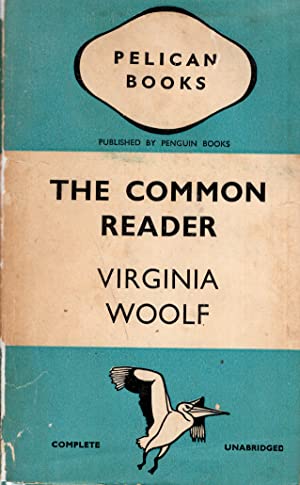
The first was Virginia collection of essays, The Common Reader. First published by the Hogarth Press in 1925, it appeared as a Pelican paperback in October of 1938. Penguin Books printed 50,000 copies, sold them for 6d, and paid the Hogarth Press an advance of £150 for the paperback rights, according to a story on the University of Exeter’s website. By the end of 1965, six Woolf novels were available as Penguins.
The arrangement turned out to be mutually beneficial for both Penguin and the Woolfs, particularly since Leonard was interested in making Virginia’s work available to a wide audience.
To come up with her conclusions, Vike Plock used archival resources held at the University of Bristol. Her article takes note of the different stages, key actors, and main considerations that contributed to Virginia’s gradual assimilation into Britain’s paperback industry.
Adding a feminist perspective
However, Vike Plock explores more than the financial considerations of the deals between Penguin and Leonard. She also explores them from a feminist perspective.
The materials in the Penguin archive work in support of critical narratives arguing that Woolf’s works were posthumously seized by a patriarchal, institutional culture she had repeatedly and vociferously criticized,” she states in the abstract for her article.
It is with great sadness that I share news of the passing of Cecil Woolf, the oldest living relative of Virginia and Leonard Woolf, who died Monday, June 10, 2019, in London at the age of 92 after suffering a stroke. He was also a dear personal friend and a much-loved member of the Woolf community, revered by scholars and common readers alike.
Cecil Woolf stops at 46 Gordon Square, London, while giving Blogging Woolf a tour of Bloomsbury in 2016.
A mentor and friend
A speaker at Woolf conferences and the founder and publisher of Cecil Woolf Publishers, a small London publishing house in the tradition of the Woolfs’ Hogarth Press, Cecil was also a tremendous mentor and friend to the many Woolf scholars, both new and old, that he met at Woolf-related events.
I was lucky enough to meet Cecil at my first Woolf conference, the 17th, held at Miami University of Ohio in Oxford. I had just completed my Master’s degree at Kent State University in Kent, Ohio, for which I had written my thesis on Woolf and war.
Drew Shannon, organizer of this year’s 29th Woolf conference, which ended Sunday at Mount St. Joseph University in Cincinnati, and Kristin Czarnecki, current president of the International Virginia Woolf Society, realized I was a newcomer and graciously took me under their wing. In the process, they pointed out Cecil Woolf. I was awed, excited, and determined to meet him.
The next day, I wasted no time introducing myself to this famous but amazingly approachable gem of a man. We hit it off immediately and a 12-year friendship began, during which Cecil published five monographs I wrote for his Bloomsbury Heritage Series. Throughout those years, we corresponded by Royal Mail and email, with Cecil offering gentle encouragement, helpful advice, recommended reading, and moral support. Later, I learned that all his authors received the same considerate care. I was not surprised.
Paula Maggio of Blogging Woolf and Cecil Woolf at his London home in June 2018.
A street-haunter and host
Ever the gracious host for newcomers to his city of London, Cecil gave me a personal tour of Bloomsbury after the 2016 Woolf conference. We spent seven hours exploring Bloomsbury together, with one stop for lunch and another for tea. Throughout our six-mile walk on that fine June day, the conversation with this witty, insightful, and well-read man never flagged.
Knowing I was alone in London, he and his wife Jean Moorcroft Wilson also hosted me for dinner at their London townhouse during that trip, a meal we ate on the table where Virginia and Leonard worked at the original Hogarth Press. I was thrilled.
My little “mascot” Virginia on the Hogarth Press table at the home of Cecil Woolf and Jean Moorcroft Wilson.
I was so thrilled by the experience that I left behind my small Virginia Woolf doll — which Cecil always called my “mascot” — after setting her up for a photo shoot on the Hogarth Press table. Upon arriving at my hotel without her, I emailed Cecil about my forgetfulness. He graciously delivered my little Virginia the next day, adding a bit of whimsey. He delivered her in a box wrapped in white paper and marked with the address of my hotel. Included was a clever card that read, “Dear Paula, I’ve come home! Love, Virginia XX”
Cecil and Jean regularly invited Woolf scholars and common readers into their home, where the wine was plentiful, the food expertly prepared, the company delightful, and the ambiance distinctly Bloomsbury.
After the 2017 event, they held a post-conference party, where art by Duncan Grant and Vanessa Bell surrounded guests. And after the 2018 conference in Canterbury, the couple hosted a dinner for a small group of Woolf conference attendees still in London.
A speaker and presence
Cecil Woolf with his 2017 monograph, The Other Boy at the Hogarth Press.
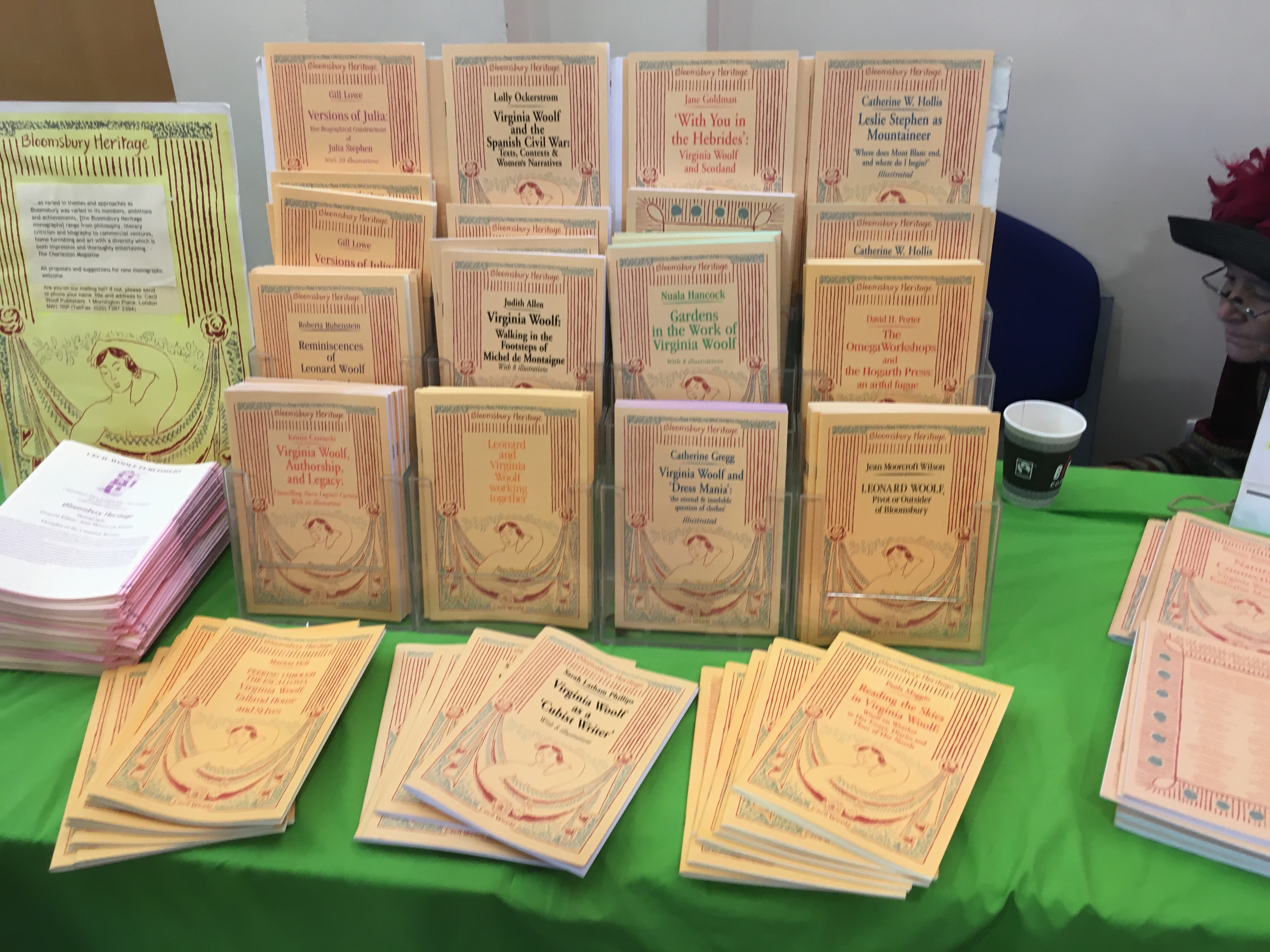
At conferences, Cecil displayed and sold his volumes in the Bloomsbury Heritage Series and was often a featured speaker at those events. The reminiscences about his famous aunt and uncle and the time he spent with them are treasured by conference-goers.
Two years ago, at the 27th conference at the University of Reading in Reading, England, Cecil was also called upon to speak and perform a ceremonial cake cutting at the 100th anniversary of the Hogarth Press.
Cecil was often invited to assist at ceremonies honoring his Uncle Leonard. In 2014, he planted a Gingko biloba tree in Tavistock Square garden to commemorate the centennial of the arrival of Leonard in Colombo, Ceylon. Also that year, Cecil spoke at the unveiling of a Blue Plaque commemorating his uncle’s 1912 marriage proposal to Virginia at Frome Station.
Cecil Woolf cuts the cake designed by Cressida Bell for the 100th birthday party of the Hogarth Press in June 2017 at the University of Reading in Reading, England.
It is fortuitous that at this year’s Woolf conference, with its theme of social justice, an entire panel was devoted to Cecil’s publishing work on the topic of war and peace. Held on June 8, it featured papers by me and four other Woolf scholars.
The panel title was “The Woolfs, Bloomsbury, and Social Justice: Cecil Woolf Monographs Past and Present” and it included the following:
Chair: Karen Levenback (Franciscan Monastery). Introduction to Cecil Woolf Publishers
Lois Gilmore (Bucks County Community College), “A Legacy of Social Justice in Times of War and Peace.”
Paula Maggio (Blogging Woolf, Independent Scholar), “Cecil Woolf Publishers: Using the Power of the Press to Advocate for Peace.”
Todd Avery (University of Massachusetts, Lowell), “Just Lives of the Obscure: Cecil Woolf, Biography, and Social Justice.”
Vara Neverow (Southern Connecticut State University) Respondent
After our panel ended, we made a commitment to publish our papers in a suitable medium. We agreed that such work should be made available to current and future scholars who want to explore, recognize, and document the legacy of Cecil Woolf and Cecil Woolf Publishers regarding topics of Woolf, war, peace, Bloomsbury, and more.
Condolences and comments
Cecil was loved and revered by countless friends and scholars around the world, including those who study John Cowper Powys, another of Cecil’s areas of speaking and publishing expertise.
Those who would like to send a message of condolence to the family may direct it to Jean Moorcroft Wilson at 1 Mornington Place, London NW1 7RP, England.
Meanwhile, I invite you to share your recollections and tributes to Cecil in the comment box located under the heading “Leave a reply” at the very bottom of this post.
Jean Moorcroft Wilson and Cecil Woolf with their display of Bloomsbury Heritage monographs at the 26th Woolf conference at Leeds Trinity University in Leeds, England, in 2016. Emma Woolf with her father Cecil Woolf at his London home in June 2017. Cecil Woolf, Jean Moorcroft Wilson, and Vara Neverow at the 25th Conference at Bloomsburg University in Bloomsburg, Pa., in June 2015. Paula Maggio of Blogging Woolf takes a break with Cecil Woolf in the Tavistock Square garden after the 26th Woolf Conference in June 2016. Patrizia Muscogiuri and Cecil Woolf chat at the 20th Woolf Conference at Georgetown College in Georgetown, Ky., in 2010. Some of the monographs in the Bloomsbury Heritage Series.
 various editions of Mrs. Dalloway, they are now available for free online, thanks to the efforts of Edward Mendelson of New York’s Columbia University.








 Alice Lowe
 Catherine
 Kaylee Baucom
 Leanne Oden
 Paula Maggio
 Stefano Rozzoni
 seanmcphail
 suzannebellamy1
 veronikakra
 Vara Neverow
 William Patrick Wend
 Zoe Wolstenholme


