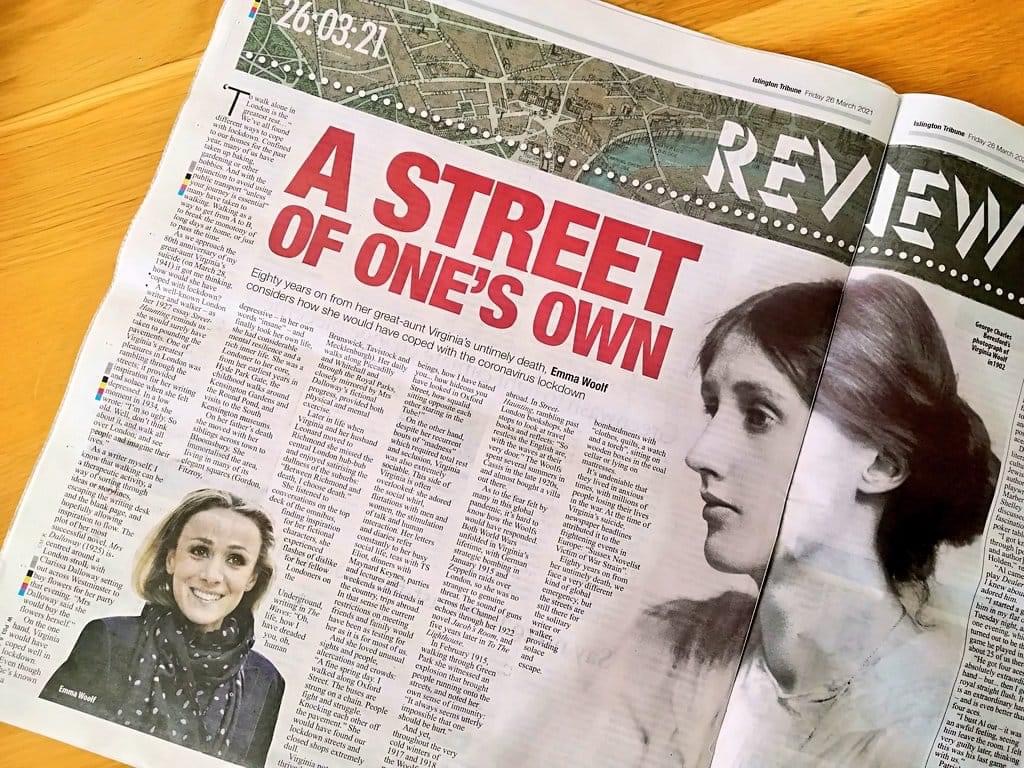
Marking the 80th anniversary of Virginia Woolf’s death, the London Library will present an online dramatization of Virginia Woolf’s iconic 1928 feminist polemic, A Room of One’s Own, on Saturday, May 1, 8-9 p.m. BST.
The dramatization is adapted by Linda Marshall-Griffiths, directed by Charlotte Westenra, and filmed in The London Library.
Tickets are £10 and are available from the London Library website.
The event is part of the three-day online London Library Lit Fest, Saturday, May 1, to Monday, May 3. Festival Passes are available that include one ticket to all 14 main events, at a cost of £25.
Ticket holders are able to watch the online events live or any time up until June 13. They will be sent a link 24 hours before the event.
Is it today? Or was it yesterday? The date of the centenary anniversary of the publication of Virginia Woolf’s short story collection Monday or Tuesday is under debate, the Virginia Woolf Society of Great Britain admits.
Roundtable participants at the 27th Annual International Conference on Virginia Woolf in 2017 sit below a screen showing a digitized ledger sheet from the Hogarth Press.
The society celebrated the centenary with an email message to members and a post on its Facebook page that included mention of the date disparity, background about the book, and a list of the stories in the 1921 volume, the only collection of Woolf’s short fiction published in her lifetime.
Short stories in Monday or Tuesday
A Haunted House
A Society
Monday or Tuesday
An Unwritten Novel
The String Quartet
Blue & Green
Kew Gardens
The Mark on the Wall
About the book
Leonard and Virginia handset the type for Monday or Tuesday, which was the first of Woolf’s hardback books published by the Hogarth Press.
Vanessa Bell created the cover art, as well as the four woodcuts that appear inside the Hogarth Press edition.
Art and content aside, in Beginning Again, Leonard described it as “one of the worst printed books ever published, certainly the worst ever published by The Hogarth Press” (239).
I just stumbled across a saved email from two years ago that included a link to a 16-minute YouTube video that provides a photographic timeline of Virginia Woolf’s many looks, from youth to adult, from formal to playful.
The music accompanying the timeline, which I am belatedly sharing, is by Philip Glass, who also composed the music for the 2002 film “The Hours.”
“80 years ago today the world lost a great writer in Virginia Woolf. However, we would prefer to celebrate her life, and the fact that she gave us ten novels, a biography, two feminist treatises, three dozen short stories, enough essays and reviews to fill six chunky volumes, thousands of letters, perhaps the most detailed diary by any writer, several memoirs, three Russian translations, a comic play, a juvenile newspaper, as well as numerous photograph albums. Enough material, that is, to keep Woolfians interested to the present day and beyond.”
Sigrid Nunez is most known to Woolfians for Mitz: The Marmoset of Bloomsbury, her 1998 (and reissued in 2019) fictional portrait of the Woolfs’ pet monkey, inspired by Flush, Virginia Woolf’s similar treatment of Elizabeth Barrett Browning’s dog.
Bloomsbury makes a brief appearance in her new novel, What Are You Going Through, a series of musings, meetings and memories. The nameless narrator follows some anecdotes about the divisions between women and men by reflecting that while she doesn’t like romance fiction, she’s fascinated by stories of unconventional or hopeless love. She imagines a collection of these tales, called Women in Strange Love.
She considers Dora Carrington’s unrequited love and devotion to Lytton Strachey, her marriage to Ralph Partridge and their lopsided ménage à trois to accommodate Lytton’s passion for Ralph. She recaps Carrington’s suicide two months after Lytton’s death. Virginia Woolf visited Carrington the day before and recounted that she said, “There is nothing left for me to do; I did everything for Lytton.” Woolf’s parting impression of Carrington was “Like some small animal left.”
“Women’s stories are often sad stories,” observes the narrator.
Nunez novel reflects on women’s lives—friendship, aging and death—in the context of the narrator’s response to a friend with terminal cancer. The title is a translation from Simone Weil, who said that love of one’s neighbor is being able to ask the question, Que lest ton tourment?